Blog
What data centers can learn from the automotive industry’s 800 VDC journey


As AI data centers proliferate and the industry marches toward adoption of 800 VDC infrastructures, the four Cs — complexity, constraints, competition, and cost — are compelling data center operators to rethink how IT, power, and cooling are integrated and deployed. Bespoke design and siloed disciplines are giving way to a systems-level approach that treats infrastructure as an opportunity to standardize and streamline. Through this lens, one-off projects become repeatable products engineered for faster deployment and greater operational efficiency.
Standardized equipment is just the beginning. Servers, uninterruptible power supplies (UPS), and cooling equipment already come in established product families, and successful innovation is quickly adopted across the ecosystem. Repeatability also depends on engineering the relationships among components. Rack density and processor heat profiles determine cooling requirements. Power distribution affects equipment placement, serviceability, and resilience. Network topology shapes physical layouts and expansion options.
These decisions have consequences throughout the facility. Engineers must resolve tradeoffs among cost, efficiency, and resilience early in the design process, before choices in one discipline impose constraints on another. Viewing the data center as a unified system is a good place to start. A common architecture establishes component relationships and defines the interfaces, allowing teams to carry validated designs to subsequent deployments. Think of it as an “80/20” design principle: preserve a common architectural core while accommodating site- and application-specific requirements. The proportion will vary, but the aim is consistent — reduce the engineering each new facility must repeat.
Within that architecture, power, cooling, compute, and controls must operate together. Electrical capacity has to support the planned rack density, while the cooling system must remove heat with processor operating limits. Shared monitoring and controls help manage changing loads and fault conditions. Defining these interfaces turns individual subsystems into an integrated platform that can be validated, manufactured, and deployed repeatedly.
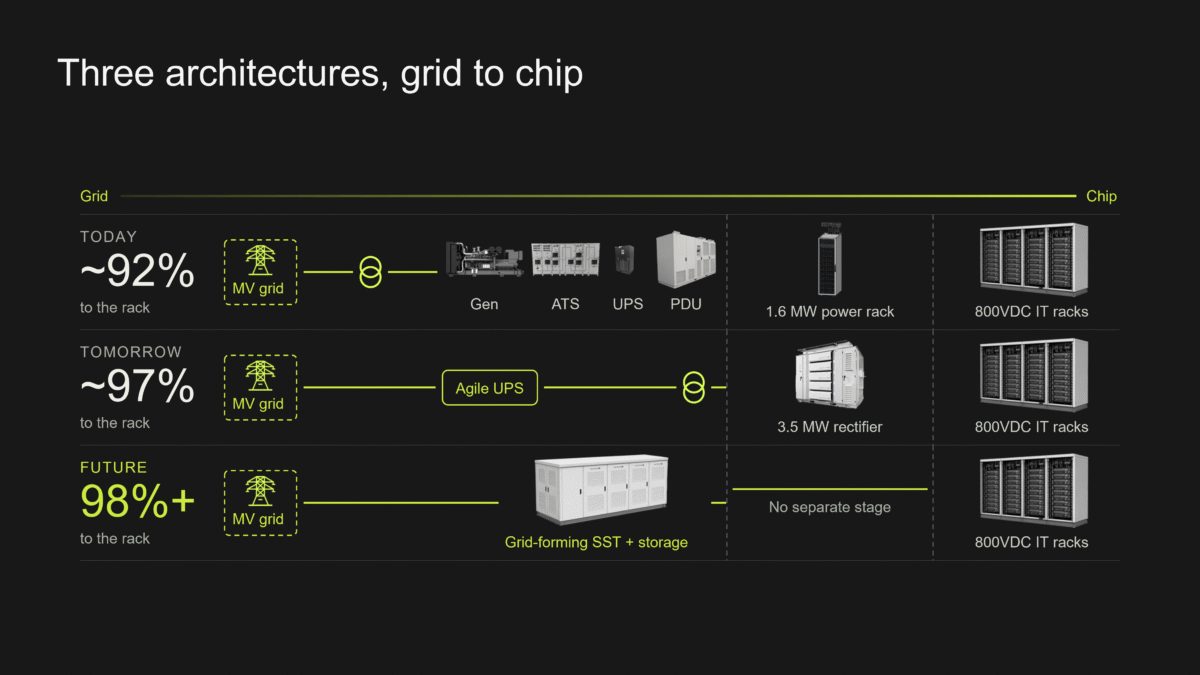
Utility power comes into a data center at medium voltage and passes through several transformation and conversion stages before reaching the processors. Each stage introduces energy losses. Today’s architecture delivers power from grid to rack with roughly 92 percent efficiency. We can do better. An 800 VDC architecture creates a more direct power path.
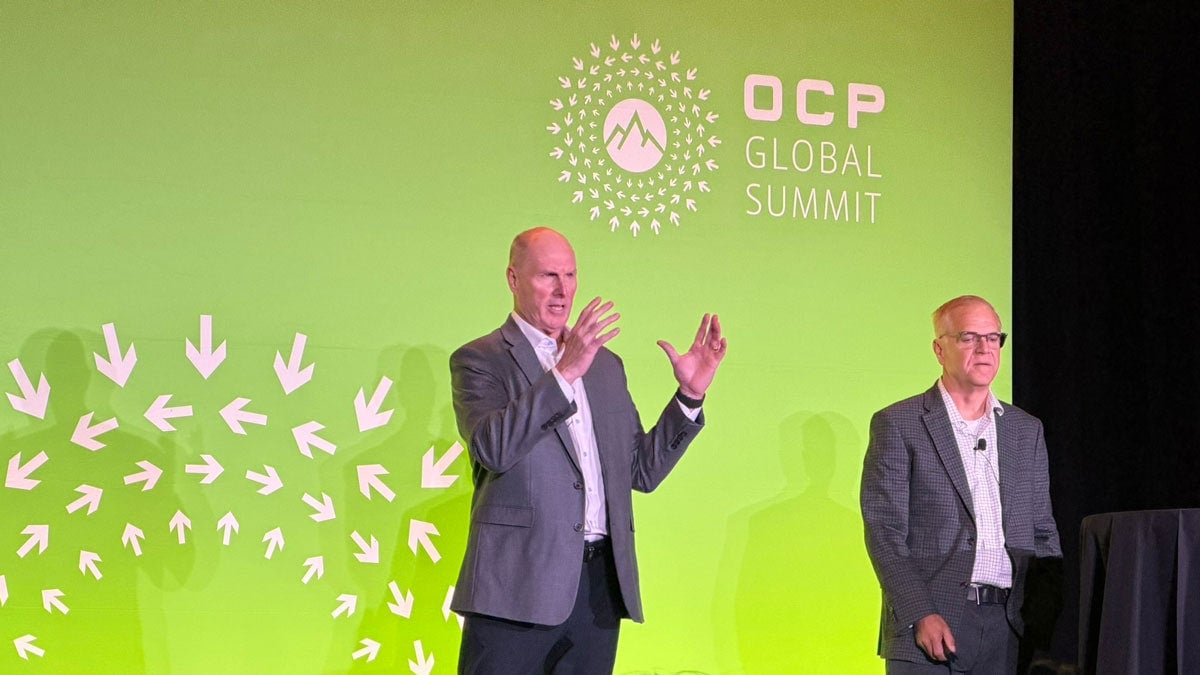
The roadmap we showcased at the recent OCP Global Summit illustrates two phases of simplification. First, the automatic transfer switch (ATS), uninterruptible power supply (UPS), power distribution unit (PDU), and power rack are consolidated into an agile UPS coupled with a centralized rectifier unit for power conversion. Less equipment, fewer conversion steps, more efficient power delivery. This configuration, in which the rectifier monitors both grid performance and compute load, leads to up to 97 percent energy efficiency at the rack. It also lowers the risk of power disturbances that can impact the data center, the utility provider, and other energy consumers that depend on it.
The next phase uses a solid-state transformer (SST) with optional energy storage that increases that to up to 98 percent. With SSTs still in development, however, we encourage ecosystem participants to explore the options that already exist to produce meaningful efficiency gains. SSTs are approaching commercial scale with some manufacturers anticipating volume shipments by 2028, but there is no firmly established date for widespread data center availability.
Flex’s acquisition of EPC Power supports this transition to more efficient power architectures. EPC develops power conversion systems with integrated software and grid-forming controls. Its portfolio includes rectifiers and DC-DC conversion, with SST development on the roadmap. The acquisition complements Flex’s power, cooling, and compute portfolio with technologies for grid stabilization, backup power, and 800 VDC delivery that provide:
EPC Power is part of Flex’s Cloud and Power Infrastructure (CPI) segment, which Flex plans to separate into Axiom, an independent publicly traded company, in the first quarter of calendar 2027.
As compute density increases, thermal design becomes inseparable from system performance. AI accelerators differ in total heat output and distribution of heat across the die. Some have relatively uniform heat profiles. Others have concentrated hot spots that require targeted cooling. Cold plate design must account for these differences alongside coolant temperature, flow rate, and pressure drop.
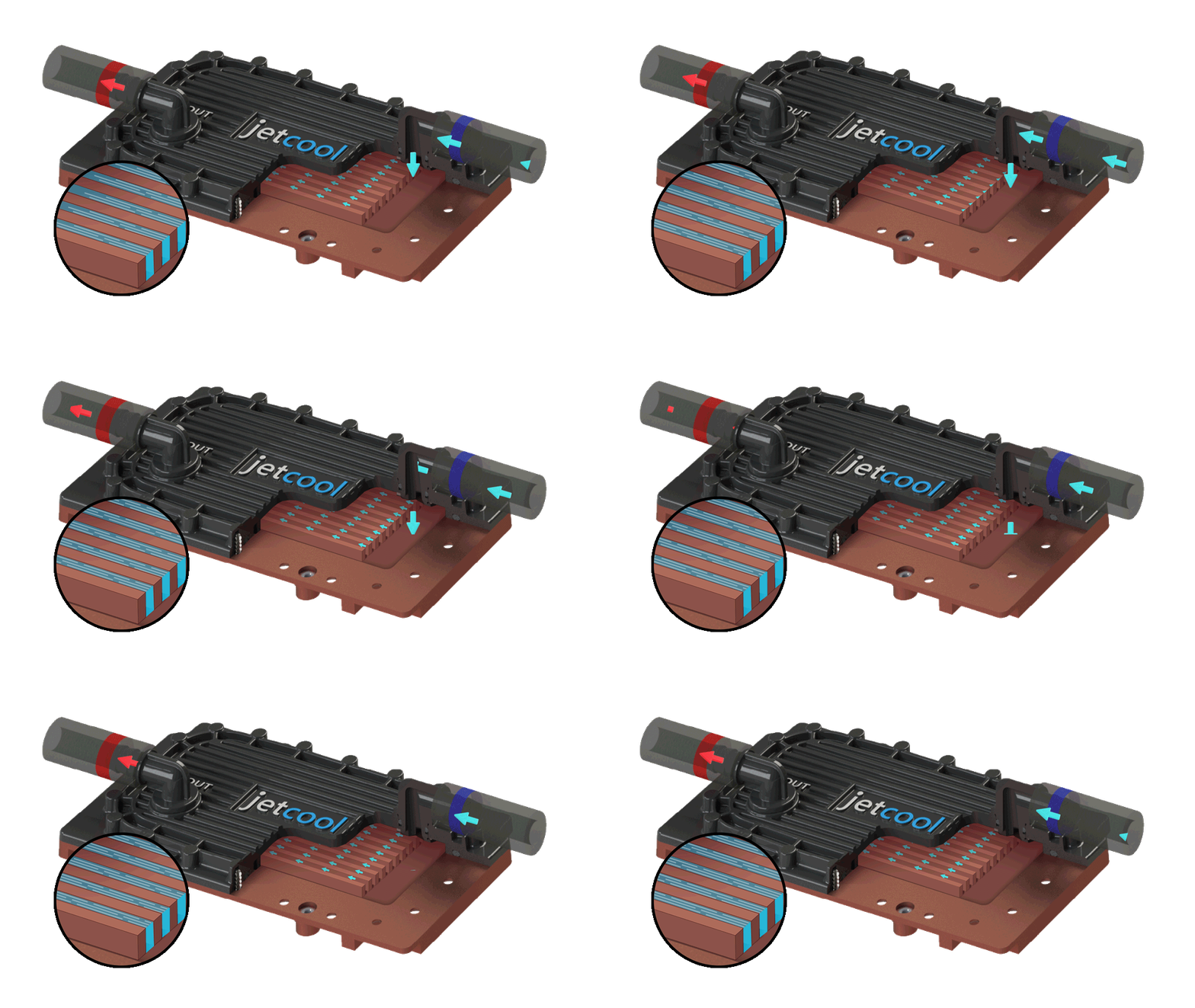
Microchannel cooling directs coolant through parallel internal channels. It suits uniform heat profiles and provides efficient cooling at low to moderate flow rates, reducing demands on the IT cooling loop.
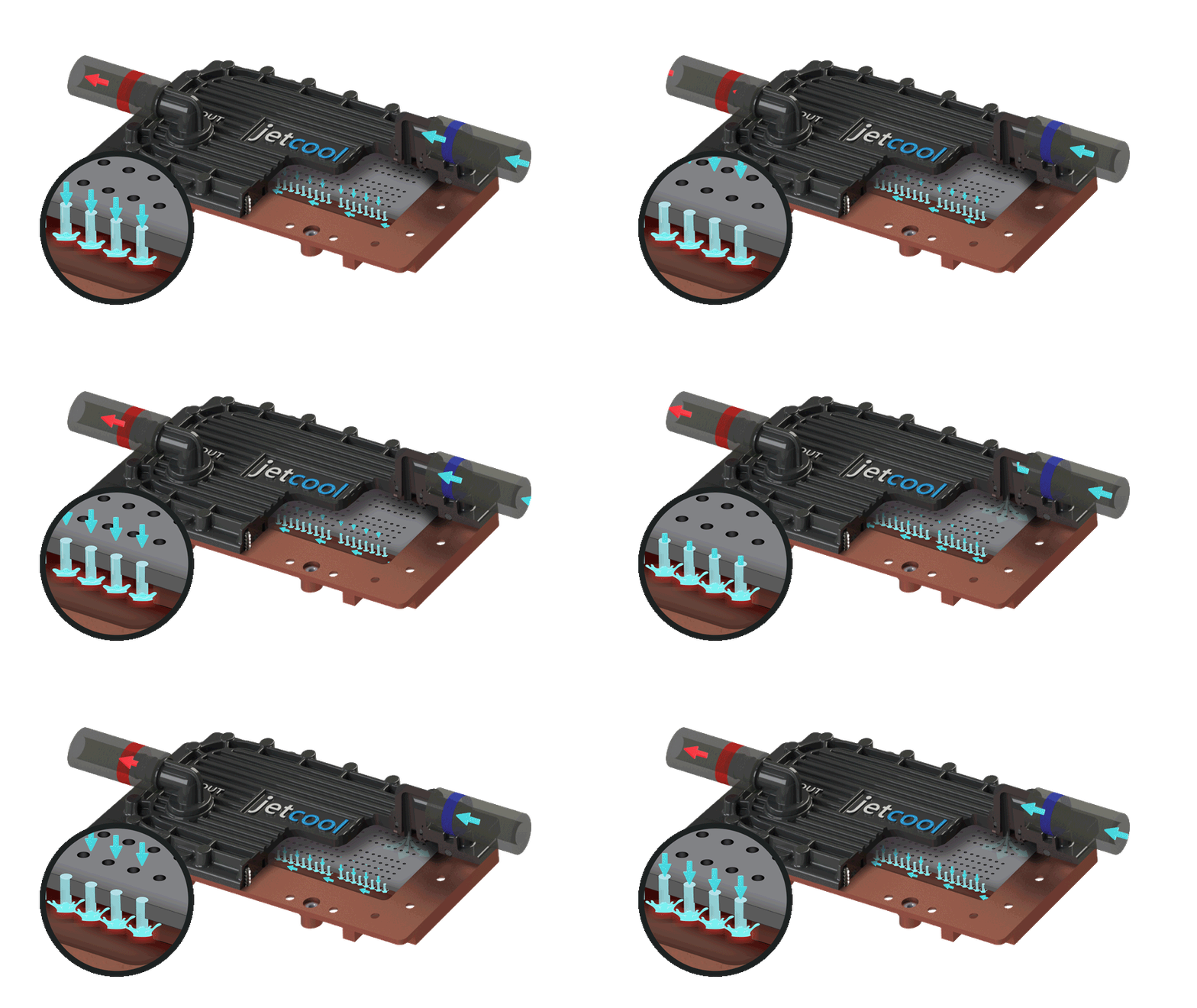
Microconvective cooling® uses targeted jet arrays to address processor hot spots. It improves temperature uniformity and supports high flow rates with low pressure drop. Applications include custom accelerators, warm-water cooling, and direct-to-die cooling.
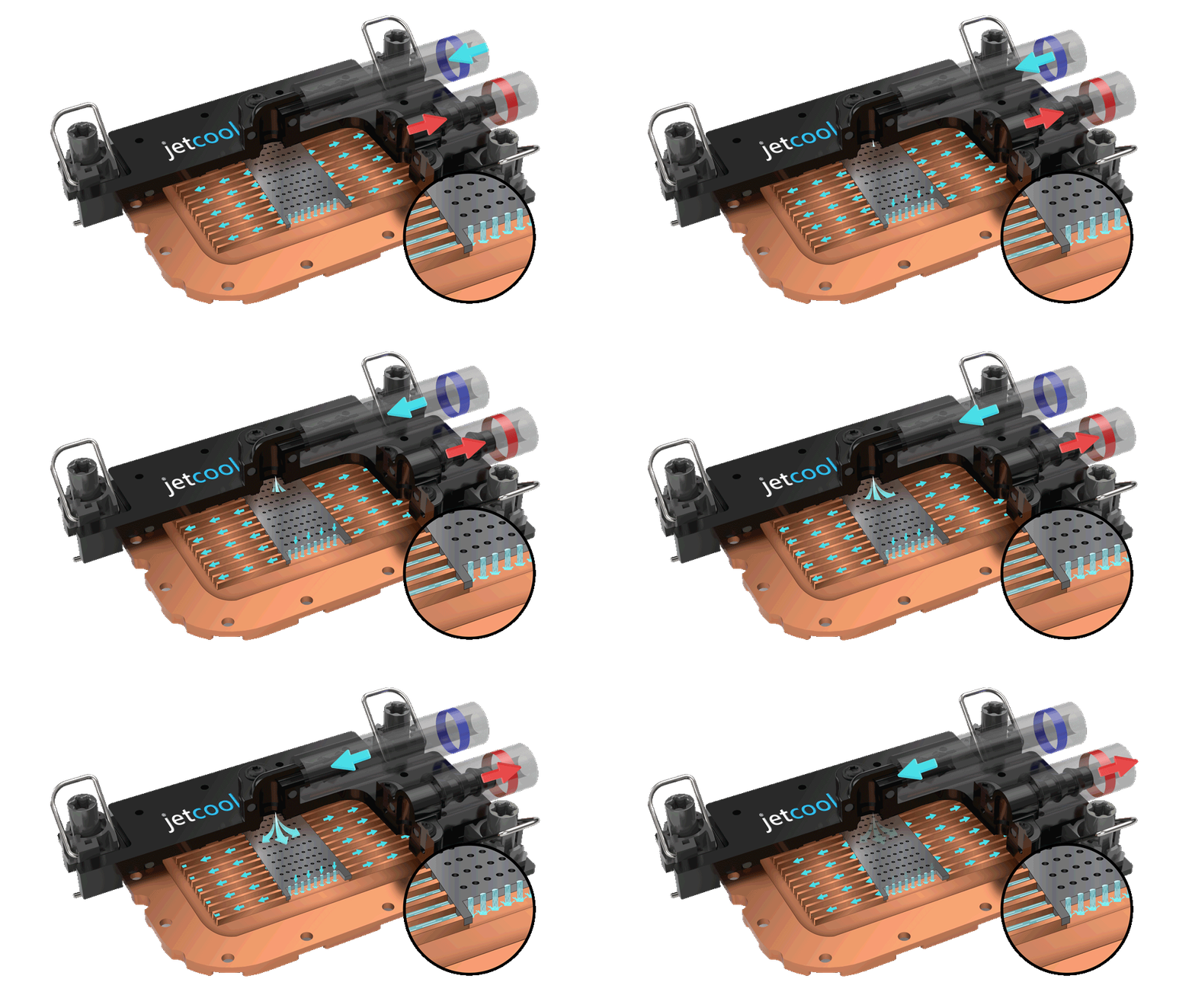
Hybrid cooling combines jets and microchannels for custom silicon with uneven heat profiles. Engineers can tune heat transfer and hydraulic performance to the processor’s requirements.
The choice affects the wider cooling system. Flow rate and pressure drop influence pumping requirements, while coolant temperature affects facility heat rejection. Evaluating the cold plate within those operating conditions connects chip-level performance to facility costs. An annual cost analysis comparing standard cold plates with our microconvective cold plates for a 40 MW data center in Virginia estimated savings of 400 million liters of water and $2.5 million in cooling costs per year. This analysis showed that when cooling is optimized around the workload and the silicon, the result is up to 47 percent cooling savings at the rack or chip level.
Modularization translates the architecture into physical building blocks that engineers can configure, manufacture, and deploy repeatedly. Power pods and skids combine electrical equipment, interconnections, and controls in pre-engineered assemblies. Enclosed pods support outdoor installations, while open-frame skids house equipment within a building. Across the AI infrastructure, coordinated modules align power capacity with compute and cooling requirements.
Factory construction and site construction can proceed in parallel. Manufacturing teams connect equipment and test its operation before shipment, resolving integration issues while systems remain accessible in a controlled environment. Equipment arrives on site with more of that work complete, reducing field cabling and troubleshooting. On-site connections and final commissioning verify performance within the completed facility.
The prefabricated AI modules introduced by Flex at OCP demonstrate this approach. They combine 800 VDC power racks, advanced coolant distribution units (CDUs), and high-density IT racks into pre-engineered, factory-built systems, reducing deployment timelines up to 50 percent compared with traditional construction approaches.
Defined modules also support phased expansion. Operators can add capacity in planned increments using established configurations while manufacturers refine production and testing across successive deployments. Each project builds on engineering and manufacturing work already completed.
As engineers balance power delivery and thermal management across the data center infrastructure and take advantage of modular designs, system-level benefits accrue. A unified system provides a foundation for optimizing power delivery, cooling, and compute in tandem. Deployments become repeatable, with fewer components to manage. Iterative improvements and site-specific adjustments replace one-off designs. AI capacity comes online faster and operates more efficiently throughout its lifecycle. Building infrastructure as an integrated system — not isolated components — turns an industry rallying cry for “faster time to token” into an executable path to what’s next.
Efficiency and savings data via Axiom analysis as of October 2026; savings data is illustrative only.