Blog
Understanding the medium-voltage bottleneck in AI expansion
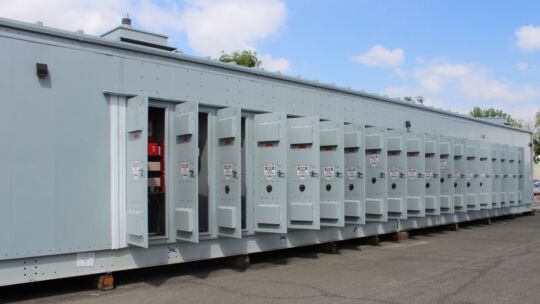
Utilities, industrial facilities, and data centers have been using medium-voltage (MV) E-houses for decades to safely house and protect electrical equipment and auxiliary systems within self-contained units. While the basics of an E-house will feel familiar to any engineer — switchgear, transformers, energy backup and storage equipment, environmental and auxiliary controls — escalating demand for AI and high-performance computing is quickly changing what goes in the E-house and how those systems work together. Power densities are climbing from hundreds of kilowatts toward megawatt-scale racks. New approaches to energy storage, power conversion, protection, and controls are entering the design. The industry’s emerging transition to 800 VDC infrastructure will change the power distribution chain again.
The transition is already taking shape. More than 80 equipment manufacturers and infrastructure companies are developing products around the 800 VDC specification being advanced through OCP by NVIDIA, Google, Microsoft, and others. Manufacturing models focused on modularization must also be capable of addressing increasingly complex architectures, rapid technological advancements, and compressed build timelines. Vertical integration has an important role to play.
The shift to 800 VDC environments is putting adaptability to the test. Moving AC-to-DC conversion upstream and distributing 800 VDC directly to compute racks significantly changes the requirements for power conversion and distribution, as well as fault isolation, fault protection, fault containment, switching, and serviceability. Higher-density AI infrastructure also changes the relationship between electrical equipment, auxiliary systems, and the compute equipment they serve. Increasing power densities can affect equipment ratings, fault-current levels, and system isolation and protection schemes at each level, along with conductor sizing, thermal management, physical clearances, structural requirements, and service access. Adding new technologies creates additional dependencies between components from different suppliers, each designed around its own operating reference designs.
Traditional AC infrastructure will continue to be built as 800 VDC architectures come online and hybrid designs emerge.
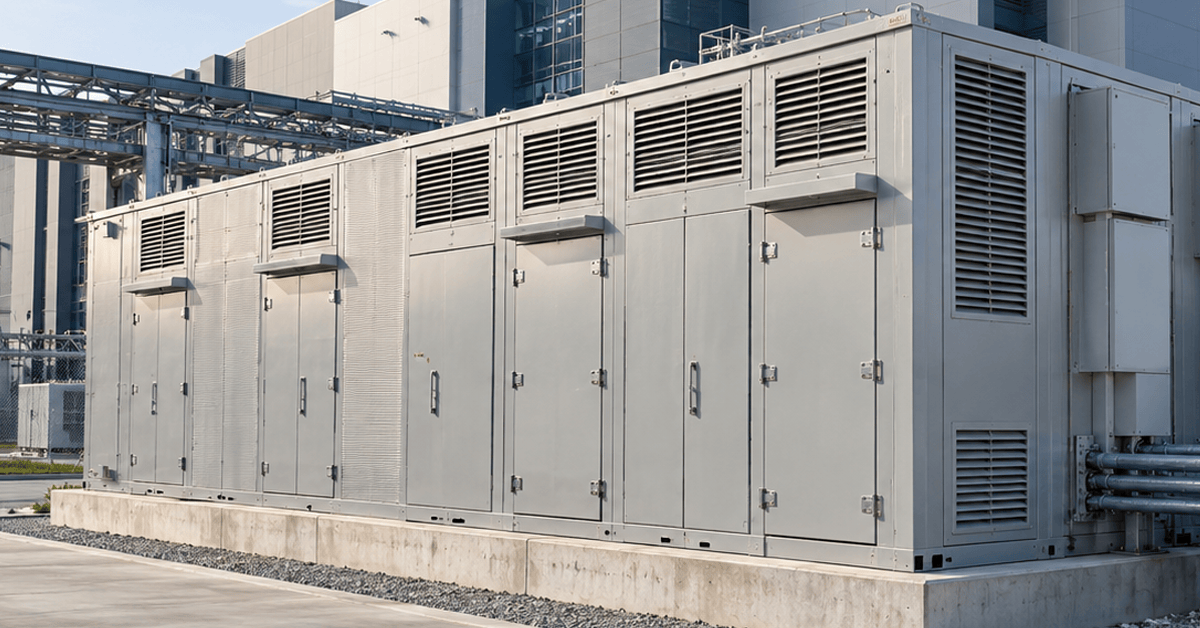
E-house manufacturers need to support multiple architectures without sacrificing the repeatability that makes modularization valuable in the first place. Larger E-houses hold more equipment, but scalable platforms accommodate changes in the electrical architecture itself. Data center operators must also contend with grid constraints, which are introducing alternative power sources such as on-site generation.
Vertical integration between core components, system design, protection scheme, assembly, integration, testing, and commissioning reduces the number of handoffs that have to be coordinated, and new technologies can be incorporated with confidence.
The goal is not simply to reproduce the same E-house more efficiently, but to create a platform that can accommodate new technologies and requirements without starting over with every new design. Incorporating intelligent digital power conversion systems into E-house designs can accelerate deployment while reducing the risk of load volatility and misalignment with utility and generator requirements.
Prefabrication alone does not eliminate the coordination required to deliver electrical infrastructure. E-houses may contain equipment from multiple suppliers, each with its own engineering requirements, schedules, connections, and testing procedures. Long lead times for critical electrical equipment and labor shortages put deployment schedules at risk. Vertical integration addresses complexity earlier in the process by bringing engineering decisions, supply chain considerations, and validation closer to the beginning of the development cycle.
Changes in one part of an E-house quickly affect another. A different piece of switchgear alters the enclosure layout. A component substitution introduces new electrical or mechanical requirements. Connecting engineering, sourcing, fabrication, and manufacturing creates a shorter feedback loop that informs engineering decisions and carries lessons into subsequent designs.
Equipment availability influences whether a design can be reproduced at the right volume in the right locations. JLL reports that average U.S. data center equipment lead times are 83 percent above 2019 levels, even as manufacturers add capacity. Bringing supply chain expertise into the design process allows teams to consider qualified alternatives, common assemblies, regional sourcing options, and specifications that may unnecessarily restrict supply while changes are still practical and cost-effective.
In a vertically integrated model, the design team and test lab sit inside the same organization. Failures found in testing feed directly back into engineering. Design changes, corrective actions, and lessons learned circulate quickly instead of crossing contractual boundaries between separate companies. Over many builds, this makes each successive module more reliable and repeatable. As AC, hybrid, and 800 VDC architectures coexist, that feedback loop helps testing capabilities advance alongside the systems themselves. The growing emphasis is reflected in UL 2755:2025, which expands requirements for prefabricated modular data centers to address increasingly distributed, interconnected architectures.
As E-houses integrate more scope, from MV switchgear and transformation to LV distribution, controls, and 800 VDC conversion, the interfaces between subsystems become the most likely point of failure. Splitting them across vendors means each interface is only validated on site, with responsibility divided across contracts. A vertically integrated model provides single-vendor accountability: one organization engineers, builds, and validates the assembly together, so it can be proven as a unit in the factory, giving one point of ownership from design to energization as 800 VDC adds new conversion stages and grounding into the same enclosure.
The value of a scalable E-house platform depends on whether the manufacturing model behind it can keep pace with the technology. New equipment and power systems may require different assembly processes, tooling, safety procedures, workforce skills, sourcing strategies, and test infrastructure. Vertical integration allows manufacturing capabilities to develop alongside technology.
We combine system design, engineering, fabrication, integration, and testing with a robust portfolio of switchgear, busway, power distribution, and controls within a coordinated model.
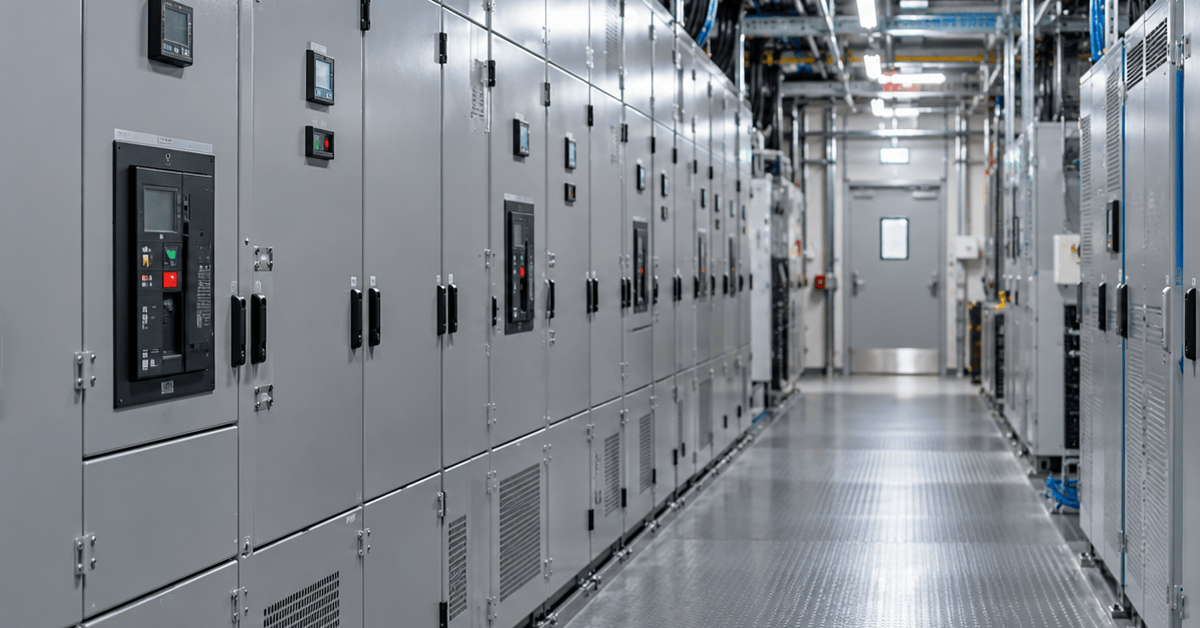
That breadth, along with advanced manufacturing and supply chain expertise, provides visibility across the decisions that determine whether an E-house moves successfully from design through production at scale.
A successful E-house program must absorb new technologies and supply conditions without sacrificing quality and predictability. As established AC infrastructure, hybrid environments, and 800 VDC architectures develop in parallel, vertical integration connects the engineering, supply chain, manufacturing, and validation capabilities needed to move each generation from design to deployment efficiently and repeatedly.