Blog
The hidden risks jeopardizing rapid AI data center expansion
As data center operators race to build out AI infrastructure, they face numerous hurdles. Some are well-documented, including power availability, sustainability pressures, and supply chain disruptions. Others receive less attention but can significantly impact roadmaps, costs, and timelines. Scale and complexity lie behind some of the biggest challenges engineers and operators must solve for today.
This series explores the hidden risks that are impacting AI data center operators’ ability to add capacity at the speed of demand:
As we noted in our discussion of changing topologies, scale and complexity are locked in a high-stakes escalation as opportunity, innovation, and constraints collide. Central to that is the way the market is structured — who’s building what and where. Hyperscalers such as Alibaba, Amazon, Google, Meta, and Microsoft are key players in the data center sector, but they’re far from alone. Colocation leaders such as Digital Realty and Equinix, along with edge/regional data center providers and neocloud companies like CoreWeave and Lambda that are focused primarily on AI workloads are also a key part of the mix.
Altogether, there are thousands of companies globally in the data center operator ecosystem and many thousands more supplying them with infrastructure systems and equipment. Everyone is eager to scale. This creates a hyper-competitive environment for everything from raw materials to finished goods to complex systems and even talent acquisition, especially in the skilled trades.
This directly affects how, and how quickly, infrastructure gets built, qualified, and deployed. Scarcity, pricing, and lead times already reflect a market where demand exceeds supply, especially in the electrical distribution and utility interconnection space. Lead times for transformers, switchgear, UPS systems, and other critical equipment are, in many cases, measured in years, not months. Bloomberg notes that despite astronomical spending on AI infrastructure — $650 billion in CapEx committed by hyperscalers alone in 2026 — many planned data centers are expected to be delayed because necessary parts and equipment simply aren’t available. Geopolitical volatility and a shifting tariff landscape put even the most resilient supply chains to the test.
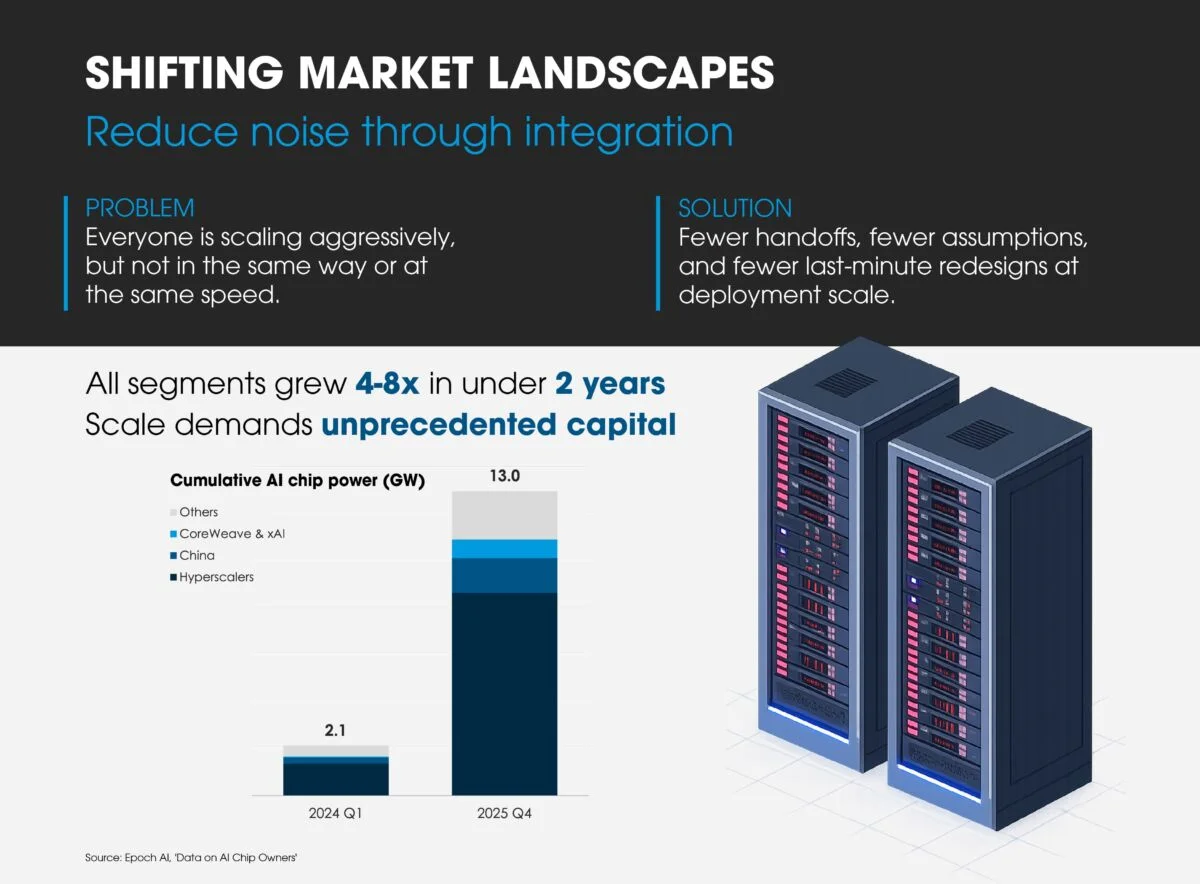
Cumulative AI chip power — for GPUs and other accelerators — can be viewed as an indicator of current and future demand, too. According to Epoch AI, it was up more than 6X in roughly 18 months, from just over 2 GW to 13.
As you can see from the chart, it’s not confined to any one subsector. Hyperscalers aren’t alone in driving demand. The ‘others’ category, which comprises neoclouds, sovereign AI programs, enterprises, and research institutions, increased roughly 4X to 5X over the same period. Growth is neither specific nor centralized. Neoclouds are a good example of what’s new. These companies didn’t just grow; they changed the shape of demand by deploying AI infrastructure at massive scale without the benefit of standardization across materials, components, equipment, or systems.
That combination creates noise. Not because growth is slowing — it’s accelerating — but because coordination is lagging. Without it, operators and suppliers alike risk inefficiencies ranging from construction downtime to poor testing and system control incompatibility that can result in additional design iterations.
The tendency toward bespoke designs is common as early innovation takes off, but it isn’t scalable. Not for individual companies attempting to establish dominance, nor for the industry as a whole trying to get ahead of demand. ‘Almost the same but slightly different’ may be a path to differentiation, but it’s an obstacle to growth.
Remember, this is an ‘and’ conversation — scale and complexity exist simultaneously, with tough engineering and infrastructure challenges that must be solved in relation to each other. Market fragmentation is not only a distraction; it eats into profitability and slows that all-important metric driving return on investment: speed to token.
Companies that lean into cooperation and co-innovation at the systems level will have a distinct advantage of those who try to go it alone or offer point solutions whose ability to integrate into complex data center environments is untested. The technical challenges are solvable, but they require an openness to engaging with like-minded ecosystem partners earlier — even those considered competitors — and deeper supply chain collaboration. Fewer handoffs, one-offs, and assumptions mean fewer last-minute redesigns and deployment delays and faster revenue realization.
For more information on data center growth in the AI era, visit https://flex.com/industries/data-center.
Next time, we’ll dive into another potent yet hidden risk data center operators must deal with: disconnected standards.