
Press Release
Flex completes acquisition of EPC Power
The relentless advance of AI, machine learning (ML), cryptocurrencies, and cloud computing is dramatically reshaping data centers. Needing to support a wide array of services from high-resolution video streaming to complex AI-driven data processing that require intensive computational power, data centers are rapidly becoming one of the largest consumers of global energy resources. The International Energy Agency has projected that if current trends continue, these data centers could consume over 1,000 terawatt-hours by 2026, a stark increase from the 460 terawatt-hours recorded in 2022.
As data centers continue to grow and adapt to keep up with processing demands, they encounter significant challenges. In an era of unprecedented data throughput, power distribution strategies are evolving to ensure energy efficiency, reduced heat generation, optimized space utilization, and effective cost management.
Traditionally, data centers were designed to handle a power supply of 30-40kW per cabinet. However, the advent of high-power CPUs and GPUs, such as Nvidia’s H100 AI accelerator which contains 80 billion transistors and has a thermal design power (TDP) of 700W, demands a re-evaluation of this standard. These components, characterized by their substantial thermal design power (TDP), push the boundaries of what conventional cooling and power systems can manage. As processing power continues to scale, the power requirements for a single cabinet will exceed 200kW.
To address these burgeoning power needs, significant adjustments to the power distribution network (PDN) are essential. The PDN must not only be robust but also adaptable to the dynamic changes in data centers. Some key considerations include:
Energy efficiency and cost management: Prioritizing energy-efficient solutions helps save energy, reducing operational costs and environmental impact.
Voltage stability: High-density server settings require stable voltages despite high di/dt scenarios and step-load changes.
Noise and interference control: With the increase in switching frequencies, mitigating electromagnetic interference has become very important.
Advanced cooling solutions: As power density increases, traditional cooling methods become inadequate, prompting the need for innovative thermal management techniques.
The implementation of Intermediate Bus Architecture (IBA) has become a cornerstone in modern data center power design. IBA enables efficient energy conversion from higher to lower voltages, fundamental for supporting the latest high-performance processors.
For example, the BMR491 series is a fully regulated quarter brick from Flex Power Modules which exemplifies advanced DC/DC conversion technology. It has the capability to deliver up to 1,300W power while maintaining strict safety standards through high-voltage isolation.
As data centers evolve away from reliance on battery backups, the integration of non-isolated, board-mounted DC/DC converters has accelerated. These converters enable high power output without the need for external isolation in the same quarter brick format, thereby optimizing both space and efficiency.
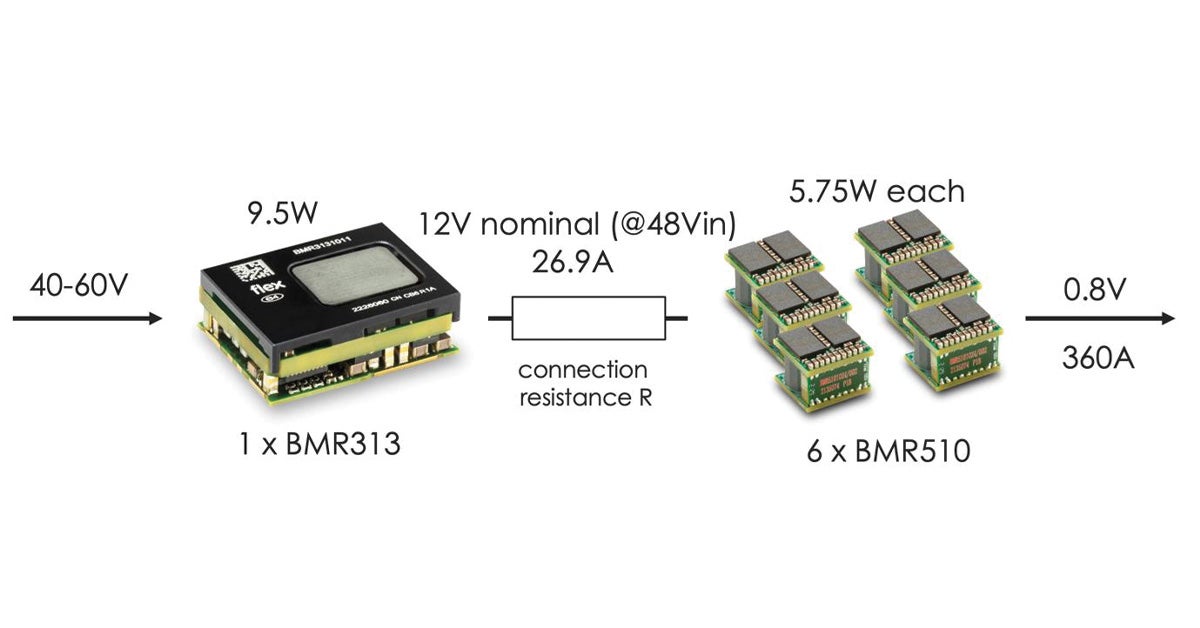
For example, the BMR351 delivers up to 1,600W of continuous power and peak power of 2,320W with an input voltage range of 40-60V, suitable for the 48V/54V applications found in data centers and a fully regulated output of 12V nominal makes it ideal to power downstream Point of Load (PoL) converters and integrated power stages such as the BMR510, along with powering circuitry that needs a tightly regulated output.
In the fast-paced environment of data centers, flexibility in voltage regulation is also paramount. Unregulated DC/DC converters provide this flexibility by allowing for conversion of input voltages to the necessary output voltages based on a ratiometric conversion. For instance, converting a 48V input with a ratio of 4:1 to a range of 10-15V output efficiently supports varied operational requirements without the need for complex regulation mechanisms.
The shift towards compact power solutions such as the BMR313 Intermediate Bus Converter (IBC) with a 4:1 input to output ratio, which delivers substantial power (1kW of continuous power and 3kW of peak power) in an ultra-small footprint, highlights an industry trend towards miniaturization to maximize efficient use of on-board surface space. These advanced compact converters facilitate higher power outputs from significantly reduced sizes, enabling more power-dense configurations that are particularly advantageous in data centers where space is at a premium.