
Contact us

Thermal management and cooling techniques

Thermal management

Thermal design for DC/DC converters is a critical aspect of ensuring the reliability and longevity of power electronics systems. DC/DC converters generate heat due to switching and conduction power losses in the components (such as semiconductors, inductors, and capacitors) during the power conversion process.

Effective thermal management is necessary to prevent overheating, which can degrade the performance of the converter and cause component failure.

To manage the heat generated in DC/DC converters, several techniques are used, including:

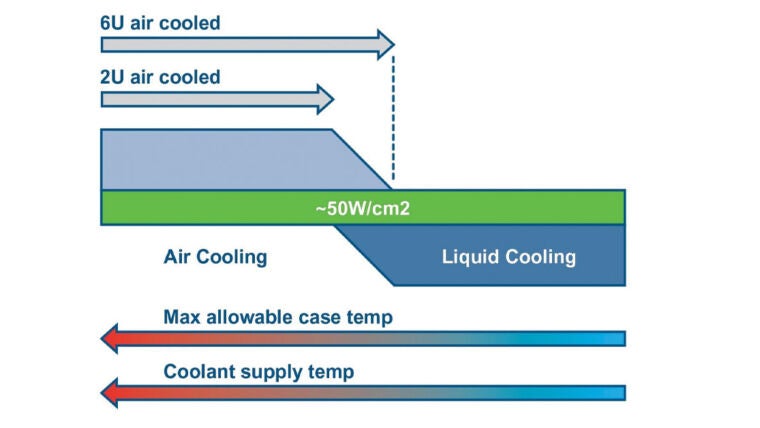
  • Forced air cooling using heatsinks: Adding heat sinks to power components, especially the power transistors, can greatly improve thermal dissipation. The heatsink’s surface area and thermal conductivity are key factors, alongside the rate of flow of cooling air.
  • Direct-to-Chip liquid cooling: Liquid cooling systems typically involve circulating a coolant (water or a dielectric fluid) through a closed-loop system that removes heat from the DC/DC converter and dissipates it in a radiator or heat exchanger. JetCool, a Flex company, offers direct-to-chip liquid cooling modules that use arrays of small fluid jets that precisely target hot spots on processors, transforming high-power electronic cooling performance at the chip or device level. More information on this technology can be found on JetCool, a Flex company’s website.
  • Immersive cooling: This is an advanced thermal management technology used to cool electronic components by submerging them directly in a specially designed coolant or dielectric fluid e.g., 3M’s Novec or Fluorinert. These fluids do not conduct electricity but are highly effective at transferring heat. There are two main forms of immersive cooling — single phase, where the cooling fluid maintains its liquid state, and two phase, where the liquid boils and changes state to a gas before condensing back to a liquid.
The basics of liquid cooling in AI data centers AI rendition of hyperscale data center
Blog
Liquid cooling is increasingly vital in AI data centers as traditional methods struggle to keep manage intense heat.
Cooling latest AI chips with liquids Cooling latest AI chips with liquids
Blog
Look at the challenges of cooling processors in data centers and how it could bottleneck performance gains.