
Pressemitteilung
Flex schließt die Übernahme von EPC Power ab
Mit dem Aufstieg von KI, maschinellem Lernen und intensiverem Cloud-Computing sehen sich moderne Rechenzentren mit einem beispiellosen Energiebedarf konfrontiert. Diese energiehungrigen Anwendungen belasten CPUs und GPUs enorm und erfordern innovative Lösungen, um Leistung und Energieeffizienz in Einklang zu bringen. In diesem Blog untersuchen wir Strategien zur Optimierung der Stromverteilung in Rechenzentren und heben Zwischenbusumrichter (IBCs) als entscheidende Komponente für die Bewältigung steigender Leistungslasten bei gleichzeitiger Aufrechterhaltung der Systemeffizienz hervor.

Neue Technologien wie KI und Kryptowährungs-Mining beschleunigen den Energieverbrauch von Rechenzentren. Laut der Internationalen Energieagentur (IEA) wird der weltweite Stromverbrauch von Rechenzentren im Jahr 2022 voraussichtlich 1000 US-Dollar betragen. erreichte 460 Terawattstunden (TWh) und könnte sich bis 2026 mehr als verdoppeln. Um dies in Relation zu setzen: Dieser Energiebedarf entspricht in etwa dem gesamten Stromverbrauch Japans.
Dieses rasante Wachstum unterstreicht den dringenden Bedarf an effizienten Stromversorgungsnetzen. Durch die Optimierung der Stromversorgungsarchitekturen können Rechenzentren ökologische Nachhaltigkeit erreichen und die Betriebskosten senken.
Aktuelle Rechenzentren liefern typischerweise 30–40 kW pro Rack, zukünftige Konfigurationen könnten jedoch 200 kW überschreiten, da CPUs und GPUs immer leistungsstärker werden. Zum Beispiel, NVIDIAs H100 KI-Beschleuniger Es arbeitet mit einer thermischen Verlustleistung (TDP) von 700 W, und Modelle der nächsten Generation wie das Blackwell B200 Es wird erwartet, dass die Leistungen 1.200 W erreichen. Um diese Leistungspegel zu bewältigen, müssen PDNs Herausforderungen wie die Bewältigung hoher Ströme bei niedrigen Spannungen, die Minimierung von Spannungsabfällen und Leistungsverlusten sowie die Implementierung effektiver Kühllösungen bewältigen. Die Optimierung des PDN umfasst Kennzahlen wie Energieeffizienz, Leistungsdichte, Rackplatznutzung und Kosteneffizienz.
Aufgrund der Ineffizienz der direkten Hoch-Niederspannungswandlung setzen Rechenzentren zunehmend auf die Zwischenbusarchitektur (IBA). Diese Strategie unterteilt die DC/DC-Wandlung in zwei Stufen und nutzt Zwischenspannungen zur Verbesserung der Gesamteffizienz. Beispielsweise reduziert die Verteilung der Leistung bei 48 V oder 52–54 V die Stromstärke und minimiert die Widerstandsverluste. In einem IBA-System übernimmt ein Zwischenbuswandler (IBC) die erste Stufe der Spannungsreduzierung. Diese Wandler können isoliert oder nicht isoliert sein. Neuere Entwicklungen begünstigen nicht isolierte Designs aufgrund ihrer höheren Leistungsdichte. Dadurch kann der Bedarf an Isolation in den auf der Platine montierten DC/DC-Wandlern reduziert werden, da die Sicherheitsverantwortung auf das AC/DC-Netzteil (PSU) verlagert wird.
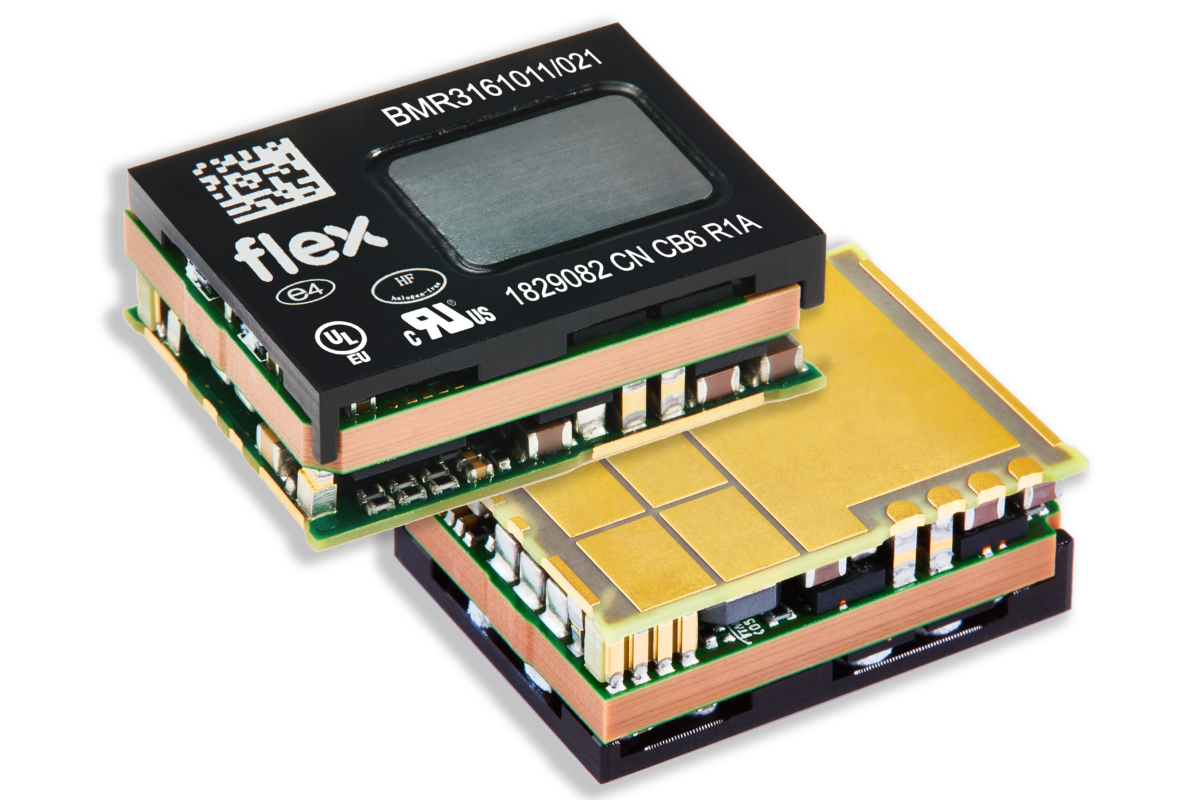
Moderne IBCs bieten eine beispiellose Leistungsdichte und Effizienz. Zum Beispiel die Flex-Leistungsmodule.’ BMR316 Es liefert 1 kW Dauerleistung und bis zu 2,8 kW Spitzenleistung in einem 80%-Gehäuse, das kleiner ist als herkömmliche Designs. Dank dieser Kompaktheit können KI-orientierte Rechenzentren nicht-isolierte, ungeregelte IBCs für ein überlegenes Energiemanagement einsetzen.
IBCs mit festem Übersetzungsverhältnis, beispielsweise 4:1 oder 8:1, bieten maßgeschneiderte Lösungen für spezifische Systemanforderungen. So ermöglicht ein Verhältnis von 4:1 eine höhere Leistungsdichte und verbesserte thermische Eigenschaften, während ein Verhältnis von 8:1 besser für geringere Eingangs-/Ausgangsspannungsdifferenzen geeignet ist und einen optimalen Ausgleich zwischen Wirkungsgrad und Strombedarf gewährleistet.
Mit steigender Leistungsdichte in Rechenzentren stoßen herkömmliche Luftkühlungsmethoden an ihre Grenzen. Flüssigkeitskühltechnologien wie die Direkt-auf-Chip-Kühlung von Partnerunternehmen wie beispielsweise JetCool, Immersionskühlung gewinnt zunehmend an Bedeutung. Diese Lösungen gewährleisten eine effiziente Wärmeableitung, die für die Bewältigung der thermischen Belastungen kompakter Hochleistungskomponenten unerlässlich ist.
Um Platz und Leistung zu optimieren, Vertikale Stromversorgung (VPD) integriert Spannungsreglermodule Die Spannungsreglermodule (VRMs) befinden sich direkt unterhalb der CPUs oder GPUs. Diese Konstruktion minimiert die Verbindungslängen, reduziert Leistungsverluste und spart wertvollen Platz auf der Leiterplatte. Durch die Kombination von VPD mit IBA-Systemen erreichen Rechenzentren eine noch höhere Effizienz und Flexibilität.
Rechenzentren stehen vor komplexen Herausforderungen bei der Optimierung der Stromversorgung. Die Auswahl der richtigen IBC-Lösung hängt von systemspezifischen Faktoren ab, von den Spannungspegeln bis zum Wärmemanagement. Unter Berücksichtigung elektrischer, thermischer und mechanischer Anforderungen ist ein ganzheitlicher Ansatz der Schlüssel zu einem optimalen Verhältnis von Leistung und Effizienz. Für Energieingenieure, die diese Entscheidungen treffen müssen, sind Software-Design-Tools wie … hilfreich. Flex Power Designer Der Designprozess kann optimiert werden, wodurch maßgeschneiderte Lösungen für die Anforderungen moderner Rechenzentren gewährleistet werden. Mit der richtigen Energiearchitektur ist die Zukunft von KI und Cloud Computing nicht nur leistungsstark, sondern auch nachhaltig.