Papel blanco
Alimentación de 800 V CC para centros de datos: Acelerar la adopción con lecciones aprendidas de los fabricantes de vehículos eléctricos.
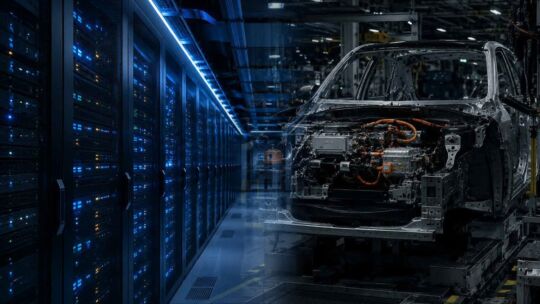
Data centers are not the first industry to confront the challenges of 800 VDC power distribution. For more than a decade, EV manufacturers have been testing, deploying, and refining 800 VDC architectures at global scale, developing critical technologies for insulation monitoring, interlock systems, battery safety frameworks, fault protection strategies, and more.
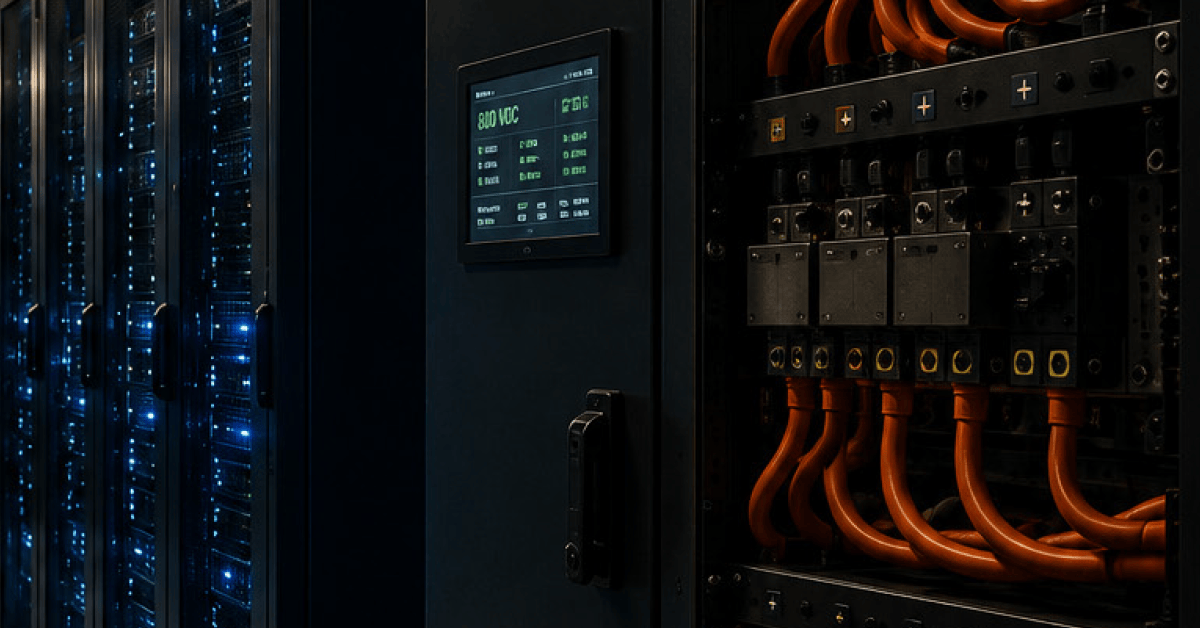
As AI infrastructure pushes data centers toward their own 800 VDC future, a new white paper from Flex and UL Solutions explores which lessons transfer directly, which require adaptation, and how those lessons can accelerate deployment while maintaining safety and reliability. The paper, Accelerating the transition to next-generation data center power architectures: Lessons learned from the development of 800 VDC electric vehicles, poses an important question: If another industry has already solved many of the technical and safety challenges associated with 800 VDC systems, what can the data center industry learn from that experience?
The rise of AI is changing the way engineers think about power distribution inside the data center. As rack densities continue climbing and GPU clusters consume more energy, traditional power architectures are being pushed past their practical limits. Every conversion stage between the utility grid and the processor introduces losses, thermal challenges, complexity, and cost.
While today’s 48–54 V architectures remain foundational in modern facilities, operators are evaluating ways to simplify power delivery and improve efficiency as infrastructure scales. This has put 800 VDC architectures squarely on the industry’s roadmap. By distributing power at higher voltage levels and reducing conversion steps, data center operators can improve efficiency, reduce copper requirements, simplify portions of the power chain, and create a more scalable foundation for future AI deployments.
Many of the concepts and technologies behind 800 VDC architectures are not new. What is new is the pace at which data centers must adopt it. Growing demand for AI infrastructure is compressing development timelines, and while the industria automotriz has had well over a decade to develop and iterate 800 VDC systems during a slow-building rollout, data center operators are trying to scale 800 VDC systems as quickly as possible. That ambition to scale quickly makes cross-industry knowledge particularly valuable.
Physics do not change simply because the application does. However, the white paper also emphasizes that data center and automotive requirements do differ in significant ways. Among them:
Understanding both the similarities and differences between the two applications is essential when adapting 800 VDC automotive practices to infraestructura del centro de datos.
One of the most compelling aspects of the automotive industry’s transition to 800 VDC is the maturity of its safety ecosystem. Modern EVs incorporate multiple layers of protection designed to prevent dangerous conditions and rapidly isolate faults when they occur. These concepts have direct relevance for future data center architectures.
The automotive industry’s widespread use of 800 VDC interlock systems offers a useful model for the way in which data center operators may approach serviceability and personal safety going forward.
Years of EV development have demonstrated the value of continuous insulation monitoring for identifying potential issues before they become safety or reliability concerns.
As data centers move toward Arquitecturas de 800 VCC and beyond, lessons from automotive fault detection and protection strategies may help inform approaches to minimizing risk and limiting fault energy.
Moving to 800 VDC is not simply a matter of changing distribution voltage. It requires power electronics capable of operating safely and efficiently within these architectures. High efficiency DC/DC converters become critical building blocks between facility power distribution and IT equipment. These converters introduce engineering considerations around:
Advances in converter topologies, semiconductor technologies, reinforced isolation methods, monitoring systems, and safety mechanisms developed for EVs can inform future data center designs and accelerate standardization across the industry.
The transition to 800 VDC architectures also changes how data center operators think about energy storage. Battery energy storage systems (BESS) are increasingly important, supporting backup power, ride-through capability, power smoothing, and the integration of renewable energy sources.
Here again, the automotive sector offers valuable lessons. The development of EVs has driven significant innovation in battery design, thermal monitoring, fault detection, protective controls, and functional safety processes. Examining these best practices can help data center operators manage the risks associated with high-energy battery systems, including thermal runaway, fault propagation, and protective coordination.
The transition to 800 VDC should not be viewed as an entirely new frontier. The automotive industry has already demonstrated that 800 VDC systems can be deployed safely, reliably, and at scale. Similar progress has been made across solar energy, industrial automation, and energy storage applications. Data center operators can leverage proven technologies, adapt established safety concepts, and accelerate standards development using knowledge that already exists. The lessons are there. It’s time to apply them.