
Blog
Adaptación de las arquitecturas IBC a los perfiles de carga de los centros de datos de IA
A medida que aumenta la demanda de centros de datos, particularmente de aquellos dedicados a atender las necesidades computacionales de IA, los sistemas de suministro de energía no solo deben seguir brindando una mayor eficiencia sino también densidad de energía.
Las arquitecturas de alimentación de los centros de datos han evolucionado para abordar el aumento de la demanda y los requisitos de carga cambiantes. Anteriormente, cada bandeja de rack tenía su propio convertidor CA/CC, lo que generaba un cableado voluminoso y costoso. Hoy en día, un convertidor de bus intermedio (IBC) simplifica el proceso con un convertidor CA/CC masivo que soporta todo un gabinete, suministrando energía CC generalmente a voltajes seguros de 48 V o 54 V para minimizar la resistencia óhmica (I2R) pérdidas y mantener niveles de corriente aceptables.
Dentro de cada módulo, un IBC transforma la entrada de 48 V en una tensión de bus intermedia (generalmente 12 V), que luego pasa a través de convertidores de punto de carga (PoL) o, más recientemente, módulos reguladores de tensión (VRM) para lograr las tensiones precisas requeridas para diversas placas y chips con las altas corrientes que suelen demandarse. Tradicionalmente, los IBC debían ser compatibles con el rango de 36 V a 75 V utilizado en aplicaciones de telecomunicaciones, pero dado que el entorno de los centros de datos ya no utiliza baterías de respaldo (sino sistemas de alimentación ininterrumpida), la tensión de entrada del IBC se puede optimizar a un rango de 40 V a 60 V o incluso más ajustado.
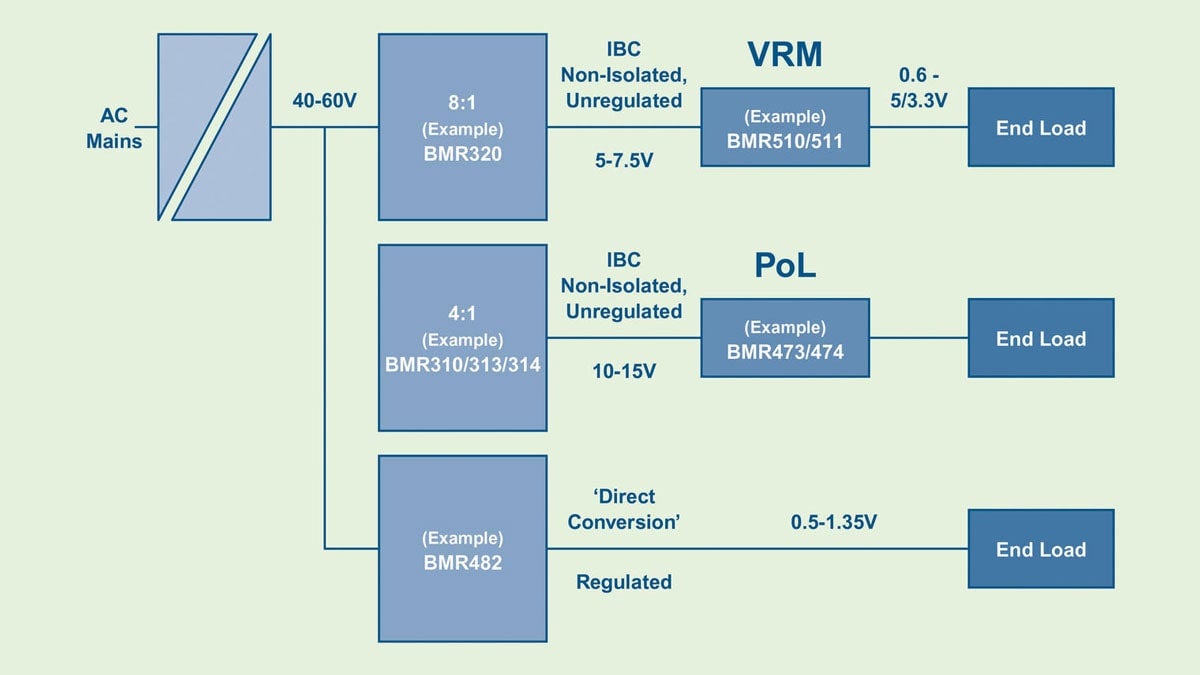
Adoptar un sistema basado en IBC tiene muchas ventajas, como una mayor eficiencia, menores costos de cableado y una mejor densidad de potencia. Sin embargo, la introducción de una etapa de conversión adicional significa que el beneficio de la eficiencia se vuelve más importante.
Flex Power Modules ha desarrollado distintos tipos de IBC, como los no regulados, los regulados y la innovadora opción de relación regulada híbrida (HRR). Los diseñadores deben evaluar aspectos como el costo, la eficiencia y las necesidades específicas del sistema para seleccionar el enfoque más adecuado.
Los convertidores IBC no regulados tienen una relación de conversión fija, como 4:1 (lo que significa que una entrada de 48 V se convierte en una salida de 12 V), lo que les permite alcanzar la máxima eficiencia, el menor coste y el tamaño más reducido. Sin embargo, su tensión de salida es directamente proporcional a la tensión de entrada, lo que implica que el convertidor PoL debe ser capaz de gestionar variaciones de tensión potencialmente grandes.
Por otro lado, los IBC regulados utilizan un bucle de retroalimentación o de avance para controlar su voltaje de salida dentro de tolerancias mucho más estrictas, pero esto significa que el IBC tiene una menor eficiencia que su alternativa no regulada. No obstante, mantener un rango de voltaje de salida pequeño puede mejorar significativamente la eficiencia del convertidor PoL.
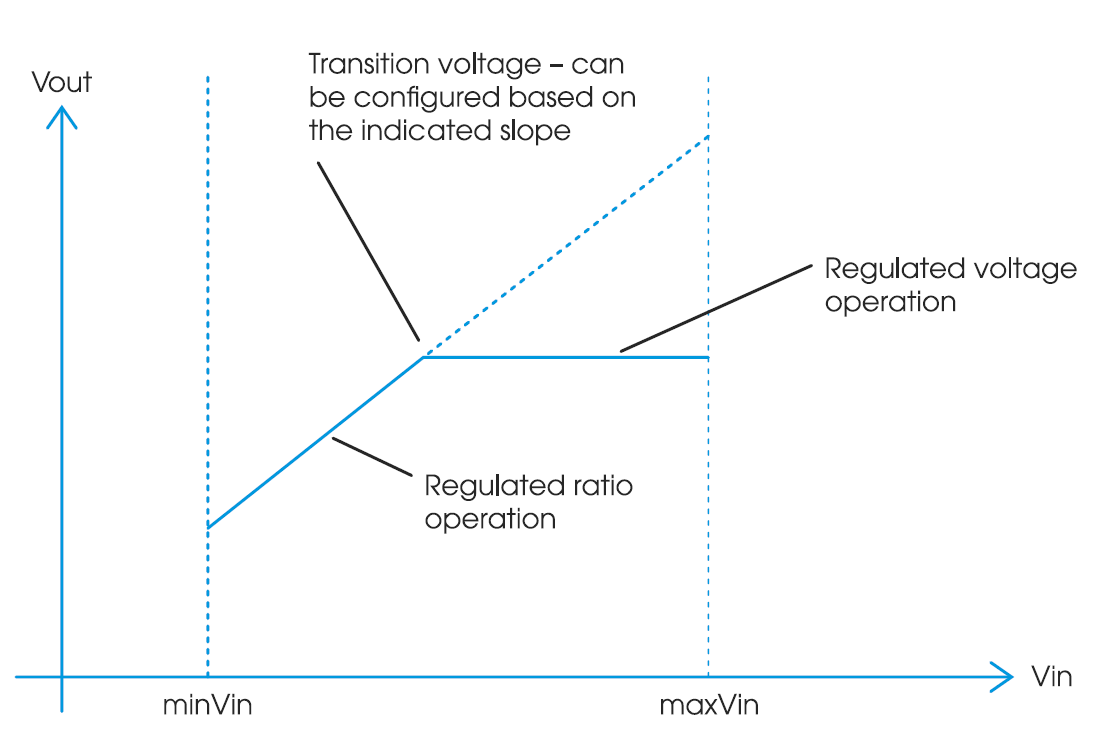
El modelo HRR combina ambos enfoques, proporcionando una regulación proporcional hasta un voltaje de entrada determinado antes de pasar a la regulación completa, combinando las mejores características de ambos sistemas para muchas aplicaciones.
Dentro de estos diferentes enfoques, existen múltiples desafíos técnicos que deben abordarse para lograr un diseño de IBC eficiente y confiable.
La aplicación inicial de energía puede generar picos de corriente de rizado, lo que podría dañar los componentes o activar los sistemas de protección contra sobrecorriente. Regular la frecuencia de conmutación o utilizar inductores de salida de mayor tamaño puede mitigar este problema.
Este método aumenta la eficiencia al sustituir los diodos por MOSFET para la rectificación, que presentan menores caídas de tensión. Sin embargo, introduce complejidad, especialmente en lo que respecta a la sincronización del control del convertidor.
Los MOSFET pueden conducir corriente en ambas direcciones, lo que supone riesgos durante las paradas repentinas. Las estrategias de control adecuadas, incluida la desactivación oportuna de los MOSFET, son cruciales para prevenir flujos de corriente inversa no deseados.
Muchos ingenieros prefieren adquirir módulos IBC completos de los fabricantes, diseñados para afrontar estos desafíos maximizando tanto el rendimiento como la eficiencia.
Los módulos de potencia Flex han introducido soluciones IBC no aisladas y no reguladas, como el BMR313, BMR314, y BMR320.
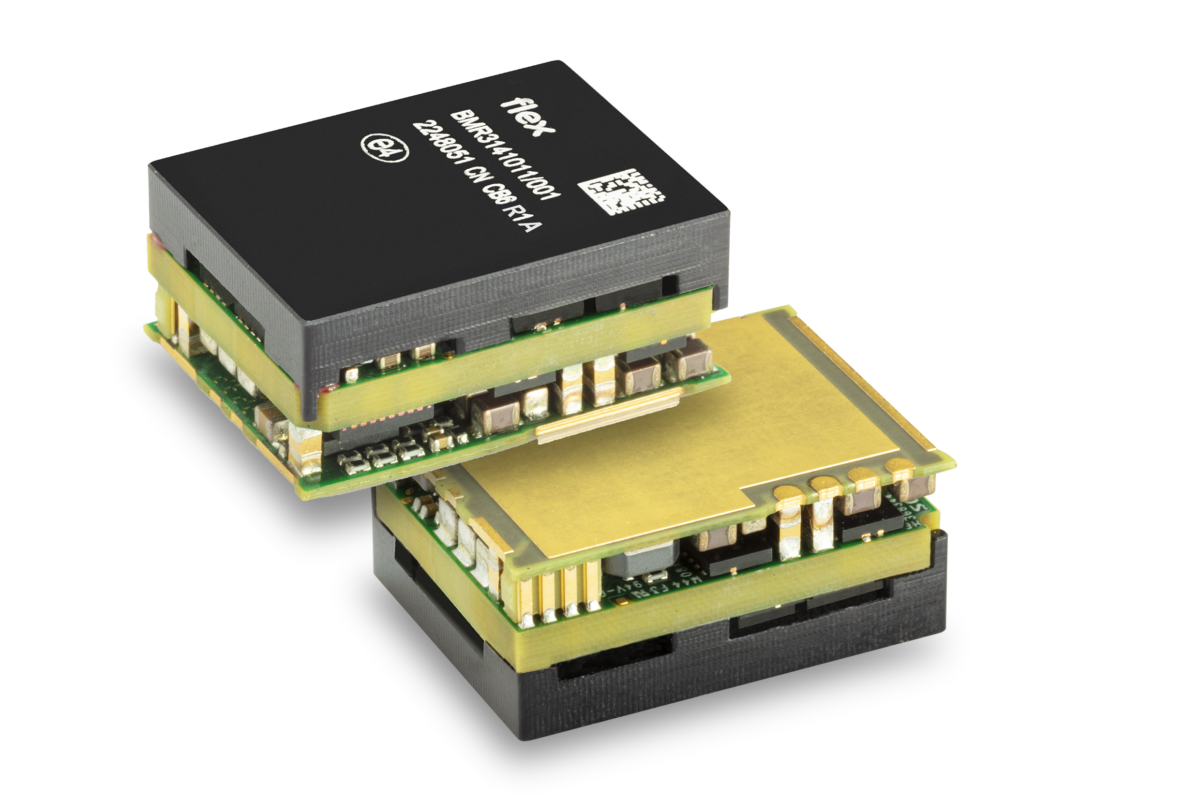
El modelo BMR313 destaca en espacios reducidos, ofreciendo una potencia máxima de 3 kW en un formato miniatura (23,4 x 17,8 x 7,65 mm), alcanzando una notable densidad de potencia de 908 W/cm³ con una relación de entrada a salida de 4:1. El BMR313 aprovecha las ventajas del FD6000, el controlador digital de bus intermedio de última generación de onsemi. Con una tensión de entrada de 54 V, la eficiencia del módulo alcanza el 97,21 TP34T con una carga de 501 TP34T (40 A).
Otro ejemplo de un IBC no aislado y no regulado con una relación 4:1 es el BMR314, que ofrece una potencia máxima de hasta 1,5 kW. Al igual que el BMR313, el BMR314 utiliza una huella LGA y una distribución de pines estándar de la industria para garantizar la seguridad del suministro y la segunda fuente de alimentación.
Además, el BMR320 es compatible con entradas de 40 V a 60 V y utiliza una relación fija de 8:1, lo que significa que el voltaje de salida oscila entre 5 V y 7,5 V. Esto lo hace ideal para aplicaciones que requieren un voltaje de bus intermedio más bajo, lo que puede ayudar a optimizar la eficiencia general del sistema cuando se utiliza junto con convertidores PoL, VRM o etapas de potencia integradas posteriores, como el BMR510 y otros.
Cada módulo está equipado con una interfaz PMBus para facilitar la monitorización, configuración y control, integrándose perfectamente con Diseñador de potencia Flex Software para facilitar la gestión sofisticada de sistemas de energía.
Los IBC no regulados son cada vez más populares en las aplicaciones de centros de datos debido a su mayor eficiencia y rentabilidad en comparación con los tipos regulados.
Además de las relaciones de entrada/salida de 4:1 y 8:1 mencionadas anteriormente, se están solicitando otras relaciones que permiten a los diseñadores de sistemas optimizar la eficiencia general del sistema. Algunos ejemplos son 5:1, 6:1 e incluso 10:1, a lo que Flex Power Modules está respondiendo con el desarrollo de nuevos productos que utilizan las topologías y los componentes más recientes, así como técnicas innovadoras de gestión térmica para lograr las mayores densidades de potencia.
A medida que la demanda de fuentes de alimentación más robustas y eficientes sigue creciendo, impulsada por los avances en la tecnología de procesadores orientada a las aplicaciones de IA, los ingenieros de diseño de fuentes de alimentación mantendrán su enfoque en la gestión térmica a altas densidades de potencia, mientras intentan mantener bajos los costos de refrigeración.
Afortunadamente, Flex Power Modules sigue siendo un líder mundial en módulos de alimentación IBC, innovando continuamente para satisfacer estas necesidades cambiantes con soluciones de alimentación fiables y eficientes.