
Presione soltar
Flex completa la adquisición de EPC Power.
Con el auge de la IA, el aprendizaje automático y la computación en la nube cada vez más intensiva, los centros de datos modernos se enfrentan a niveles de demanda energética sin precedentes. Estas aplicaciones de alto consumo energético ejercen una presión inmensa sobre las CPU y las GPU, lo que exige soluciones innovadoras para equilibrar el rendimiento con la eficiencia energética. En este blog, exploramos estrategias para optimizar la distribución de energía en los centros de datos, destacando los convertidores de bus intermedio (IBC) como un componente fundamental para gestionar las crecientes cargas de energía manteniendo la eficiencia del sistema.

Las tecnologías emergentes como la IA y la minería de criptomonedas están acelerando el consumo de energía de los centros de datos. Según la Agencia Internacional de Energía (AIE), el uso mundial de electricidad de los centros de datos en 2022 alcanzó los 460 teravatios-hora (TWh) y podría duplicarse con creces para 2026. Para poner esto en perspectiva, estas demandas de energía rivalizan con el consumo total de electricidad de Japón.
Este rápido crecimiento pone de manifiesto la urgente necesidad de redes de suministro eléctrico (PDN) eficientes. Mediante la optimización de las arquitecturas de alimentación, los centros de datos pueden lograr la sostenibilidad ambiental y reducir los costes operativos.
Los centros de datos actuales suelen suministrar entre 30 y 40 kW por gabinete, pero las configuraciones futuras podrían superar los 200 kW a medida que las CPU y las GPU se vuelven más potentes. Por ejemplo, El acelerador de IA H100 de NVIDIA funciona con una potencia de diseño térmico (TDP) de 700 W, y los modelos de próxima generación como el Blackwell B200 Se prevé que alcancen los 1200 W. Para gestionar estos niveles de potencia, las redes de distribución de energía (PDN) deben abordar desafíos como la gestión de altas corrientes a bajos voltajes, la minimización de caídas de tensión y pérdidas de potencia, y la implementación de soluciones de refrigeración eficaces. La optimización de la PDN implica considerar parámetros como la eficiencia energética, la densidad de potencia, la utilización del espacio en rack y la rentabilidad.
Dada la ineficiencia de la conversión directa de alto a bajo voltaje, los centros de datos están adoptando cada vez más la arquitectura de bus intermedio (IBA). Esta estrategia divide la conversión CC/CC en dos etapas, aprovechando voltajes intermedios para mejorar la eficiencia general. Por ejemplo, distribuir la energía a 48 V o 52-54 V reduce los niveles de corriente y minimiza las pérdidas resistivas. En un sistema IBA, un convertidor de bus intermedio (IBC) gestiona la primera etapa de reducción de voltaje. Estos convertidores pueden ser aislados o no aislados; los avances recientes favorecen los diseños no aislados debido a sus mayores densidades de potencia y a que se puede reducir el requisito de aislamiento en los convertidores CC/CC montados en la placa, ya que la responsabilidad de la seguridad se traslada a la unidad de alimentación CA/CC (PSU).
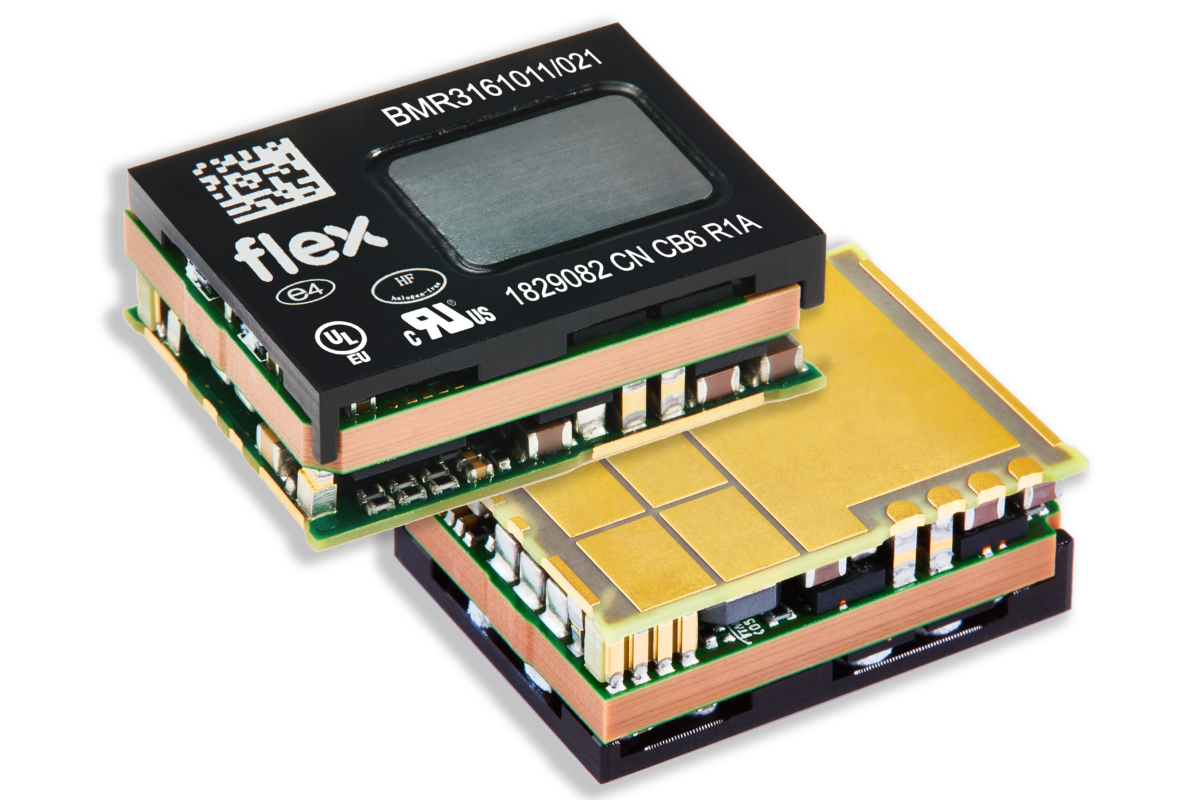
Los IBC modernos ofrecen una densidad de potencia y una eficiencia sin precedentes. Por ejemplo, los módulos de potencia Flex...’ BMR316 Ofrece 1 kW de potencia continua y hasta 2,8 kW de potencia máxima en un paquete 80% más pequeño que los diseños tradicionales. Esta compacidad permite que los centros de datos centrados en IA adopten IBC no aislados y no regulados para una gestión energética superior.
Los convertidores IBC de relación fija, como los de 4:1 u 8:1, ofrecen soluciones a medida para necesidades específicas del sistema. Por ejemplo, una relación de 4:1 proporciona una mayor densidad de potencia y un mejor rendimiento térmico, mientras que una relación de 8:1 es más adecuada para diferenciales de voltaje de entrada/salida más bajos, lo que permite equilibrar la eficiencia y la demanda de corriente.
A medida que aumenta la densidad de potencia de los centros de datos, los métodos tradicionales de refrigeración por aire resultan insuficientes. Las tecnologías de refrigeración líquida, como la refrigeración directa al chip de empresas asociadas como Enfriador a chorro, Las soluciones de refrigeración por inmersión están ganando terreno. Estas soluciones garantizan una disipación de calor eficiente, fundamental para gestionar las cargas térmicas de componentes compactos de alta potencia.
Para optimizar el espacio y el rendimiento, Distribución de energía vertical (VPD) integra Módulos reguladores de voltaje Los VRM se ubican directamente debajo de las CPU o GPU. Este diseño minimiza la longitud de las conexiones, reduce las pérdidas de energía y libera espacio valioso en la placa de circuito impreso. Al combinar VPD con sistemas IBA, los centros de datos logran una mayor eficiencia y flexibilidad.
Los centros de datos se enfrentan a desafíos complejos en la optimización del suministro de energía. La selección de la solución IBC adecuada depende de factores específicos del sistema, desde los niveles de voltaje hasta la gestión térmica. Considerando los requisitos eléctricos, térmicos y mecánicos, un enfoque holístico es clave para lograr el equilibrio ideal entre rendimiento y eficiencia. Para los ingenieros de potencia que toman estas decisiones, las herramientas de diseño de software como Diseñador de energía Flex Puede optimizar el proceso de diseño, garantizando soluciones a medida para las necesidades de los centros de datos modernos. Con la arquitectura de alimentación adecuada, el futuro de la IA y la computación en la nube no solo es potente, sino también sostenible.