

Blog
Adaptación de las arquitecturas IBC a los perfiles de carga de los centros de datos de IA
Las aplicaciones de servidor más recientes, como la IA y el aprendizaje automático, consumen mucha energía. Al mismo tiempo, los administradores de centros de datos buscan integrar más servidores blade en un rack para optimizar el uso del espacio disponible. Esto ejerce presión sobre la red de suministro eléctrico, en particular sobre los convertidores CC/CC de punto de carga o módulos reguladores de voltaje (VRM), que manejan altas corrientes en espacios muy reducidos. En respuesta, se han desarrollado VRM altamente eficientes e integrados con la carga final. Un enfoque consiste en que la etapa de potencia del VRM sea un módulo independiente, con su controlador, elegido por el usuario, ubicado en otro lugar.
Estas "etapas de potencia integradas" utilizan el espacio de forma muy eficiente y alcanzan una densidad de potencia asombrosa, de alrededor de 150 W/cm².3 o superior a partir de paquetes con una superficie de menos de 1 cm2. Sin embargo, aunque se logran eficiencias muy superiores a 90%, eso todavía significa que se deben disipar y extraer del módulo unos 10 W de potencia.
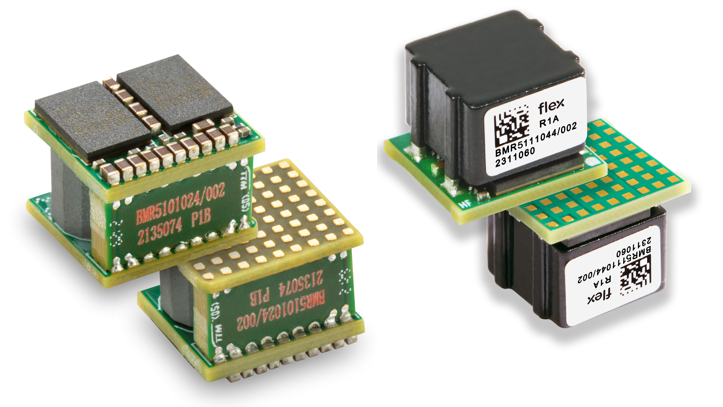
Figura 1: Módulos de alimentación Flex BMR510 (izquierda) y BMR511 (derecha), bloques de alimentación inteligentes con refrigeración superior e inferior respectivamente.
Los módulos de potencia Flex BMR510 y en BMR511 Los bloques de alimentación inteligentes son excelentes ejemplos de tecnología de vanguardia, con capacidades de corriente continua de 80 A (160 A de pico), un amplio rango de entrada de hasta 15 V y una salida configurable de hasta 0,5 V.
El BMR510 y el BMR511 (Figura 1 Los dos disipadores (izquierdo y derecho respectivamente) se distinguen por diferentes enfoques en cuanto a la refrigeración: el BMR510 se refrigera por la parte superior y el BMR511 por la parte inferior. Ambos están disponibles con terminaciones LGA o, opcionalmente, con terminaciones soldadas.
El BMR510 está diseñado de manera que los semiconductores principales que generan calor se encuentran en una placa secundaria superior con superficies de semiconductores coplanares, y que se puede acoplar fácilmente una placa fría o un disipador de calor, normalmente sujeto con una almohadilla térmica.
Una pequeña parte de la disipación de calor se produce por conducción a través del módulo y sus terminaciones hasta la placa base, y otra parte por convección al aire circundante.
Para tener esto en cuenta, los módulos de potencia Flex proporcionan un gráfico de reducción de potencia (Figura 2) que incluye la temperatura de la placa fría y la temperatura de la placa principal, lo que demuestra que se pueden extraer los 80 A completos con una entrada de 13,5 V hasta una temperatura de placa fría de 90 °C/placa de 60 °C. Esto es con una almohadilla aislante de 0,5 mm de separación, conductividad térmica de 3,5 W/mK El enfoque de refrigeración superior es adecuado para aplicaciones donde hay algo de espacio por encima de la placa principal para una placa fría o disipador de calor con aire de refrigeración forzado o por convección, o si la placa principal tiene una capacidad limitada para disipar el calor a través de su volumen y planos de cobre.
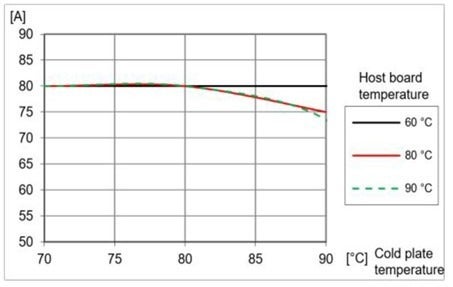
Figura 2: Reducción de potencia del bloque de alimentación inteligente BMR510 refrigerado por la parte superior en función de la temperatura de la placa fría y de la placa base.
El BMR511, en cambio, está diseñado para la refrigeración por la parte inferior, donde el calor de los semiconductores pasa principalmente a través del sustrato del módulo y a través de las terminaciones hasta la placa base.
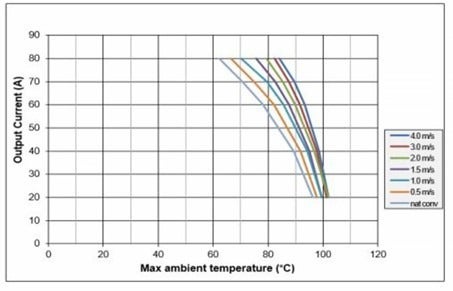
Figura 3: Reducción de potencia del bloque de potencia inteligente BMR511 refrigerado por la parte inferior en función de la temperatura ambiente y el flujo de aire especificado.
La parte superior del módulo es la superficie plana del inductor principal y también está disponible para la fijación de un disipador de calor o una pared fría para una refrigeración adicional. Como la resistencia térmica a la placa base es relativamente alta, el BMR511 se suele especificar con cierto flujo de aire y puede alcanzar su salida máxima de 80 A a más de 80 °C de temperatura ambiente con un caudal de 4 m/s., Figura 3.
Si se utiliza una placa fría, se puede obtener una salida completa de 80 A con una entrada de 12 V hasta una temperatura de la placa base y de la placa fría de 90 °C. Esto se logra con una separación de 1 mm entre las almohadillas y una conductividad térmica de 8 W/mK. La aplicación para el sistema de refrigeración inferior del BMR511 es cuando hay poco o ningún espacio por encima del módulo, se dispone de ventilación forzada y cuando la placa base está diseñada para disipar la potencia a través de sus superficies.
Todas las aplicaciones difieren en su configuración mecánica, flujo de aire y resistencias térmicas para disipar la energía térmica. Por ello, Flex Power Modules define exhaustivamente el rendimiento térmico de sus módulos. Esto implica pruebas con una orientación, caudal de aire y temperatura definidos, así como dimensiones específicas de la placa base y la placa de refrigeración, junto con sus resistencias térmicas. En las hojas de datos del producto, se identifican los puntos críticos con sus temperaturas máximas permitidas. No obstante, se incluye protección contra sobretemperatura y se puede registrar la temperatura para su monitorización remota. Como ayuda adicional, Flex Power Modules ofrece modelos térmicos para ambos productos bajo petición.
El espacio disponible sobre la placa base determina la viabilidad de la refrigeración superior mediante un disipador o una placa fría. En caso afirmativo, la capacidad de la placa para disipar el calor no representa un problema importante. Si se opta por la refrigeración inferior, ya sea por limitaciones de espacio o para ahorrar en el coste del disipador y sus fijaciones, la placa base debe diseñarse y evaluarse en función de su capacidad de disipación de calor, y normalmente será necesario un flujo de aire controlado. En ambos casos, las etapas de potencia integradas de los módulos de potencia Flex ofrecen un rendimiento óptimo con su potencia nominal máxima disponible.