联系我们

标准体系碎片化如何威胁数据中心建设进度

发表于
7 2026 年 7 月
博客 数据中心

The risks of fragmentation

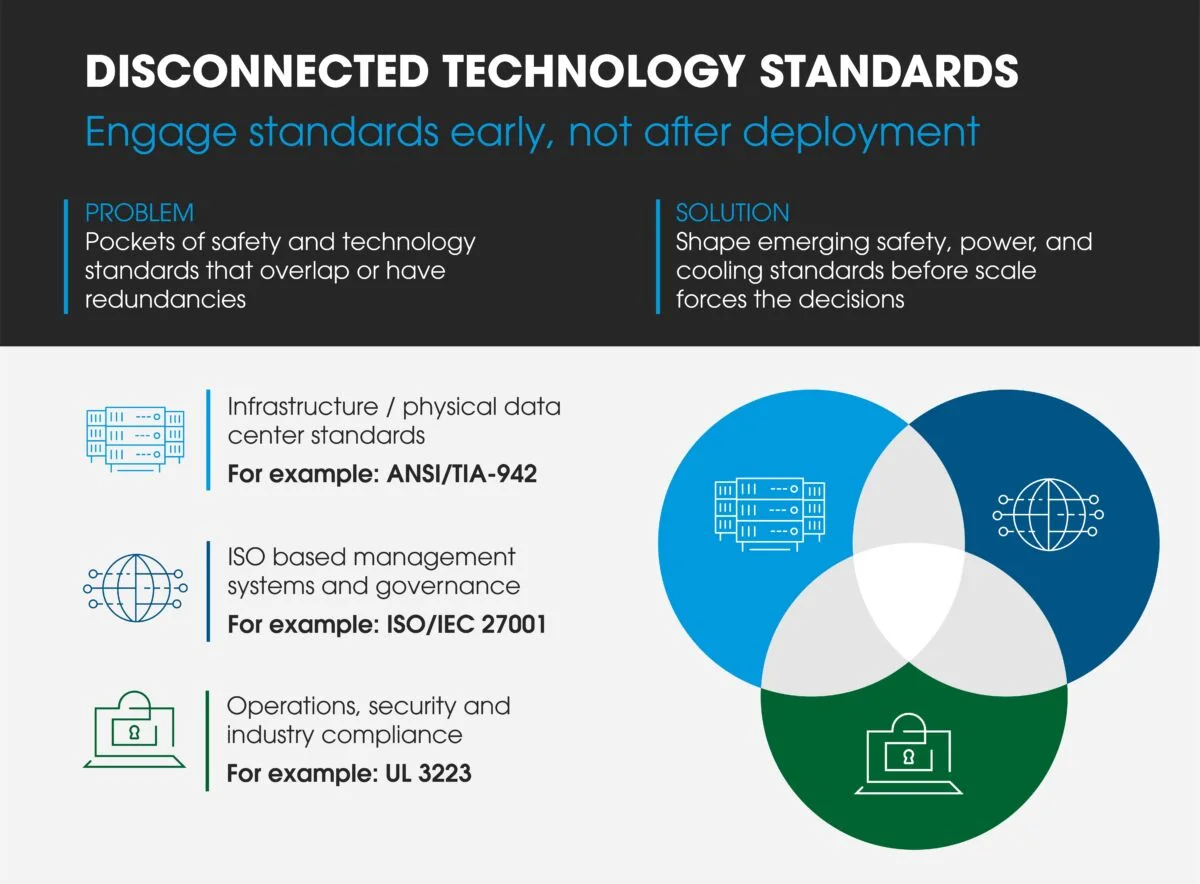
When every design, engineering, and operational choice requires parsing a labyrinth of active standards, certifications, and compliance frameworks. This can threaten even the most meticulously planned timelines. In cases where standards overlap, contradict each other, or are still in development, there is no guarantee that what is relevant today will still apply tomorrow. This is especially complicated when scaling globally. When requirements don’t align across countries or regions — a common scenario — products must be reworked for those fragmented specifications, leading to significant delays and cost-overruns. Let’s look at some examples.

800 VDC safety

As AI adoption accelerates, the industry is converging on 800 VDC for its next-generation power infrastructure. At the same time, IEC and UL safety certification pathways for 800 VDC systems are still being developed. There is no fully harmonized standard today. This means that organizations deploying 800 VDC systems in production environments right now are navigating an incomplete regulatory landscape; they’re making engineering decisions under conditions of regulatory uncertainty. The companies that published on 800 VDC safety considerations earliest, in mid-2025, are the ones that have had the most time to engage with the standards bodies and shape what those standards will look like.​ Other industries such as 汽车 have already developed common standards for the safe use of 800 VDC power infrastructures. Lessons learned there can be instructive as data centers follow suit.

Power usage effectiveness (PUE)

PUE is the most widely cited metric for data center energy efficiency. But the methodology for calculating PUE, and the enforcement mechanisms behind regulatory PUE requirements, differ between the EU’s EN 50600 standard, ASHRAE guidelines, and individual hyperscaler specifications. A facility that meets one jurisdiction’s requirements may require operational changes to meet another’s. This matters increasingly as data center operators deploy across multiple regions and jurisdictions simultaneously.​ Furthermore, focusing myopically on PUE obfuscates the need for a balanced approach to standards that is essential to a broader understanding of data center efficiency, from water use to heat reuse.

Liquid cooling flow rates

The Open Compute Project (OCP) and NVIDIA updated their recommended coolant distribution unit (CDU) flow rate targets from 1.0 LPM/kW to 1.5 LPM/kW in the past two years — a 50 percent increase. Products designed and certified to the earlier specification are potentially undersized for new deployments. The standards are moving faster than the certification infrastructure that validates compliance with them.​ They’re also moving faster than typical build timelines, which even under optimal conditions can take years from project initiation through facility operationalization. Standards changing midstream can render even the most modern AI data centers obsolete before the first token is processed.

Rack weights

As racks go from 20 kW air-cooled to 150 kW+ liquid-cooled, the physical weight of a fully loaded rack changes substantially. A fully populated liquid-cooled 250 kW rack with CDU, manifolds, and coolant can exceed floor loading specifications for facilities designed under older standards. This is an infrastructure compatibility issue that doesn’t become visible until a site survey is completed, often late in the deployment timeline.​ By then, operators are left with two suboptimal options: redesign or settle for less compute capacity.

Multiplying consequences can cost millions

The consequences of this fragmentation are concrete and measurable: redundant certification costs, longer time to market, and program delays when a validated product fails qualification for a specific customer or regional requirement. On programs deploying at gigawatt scale — where a single week of delay can cost millions — these are not minor inefficiencies. They are significant risk multipliers.​

The industry needs standards bodies, equipment vendors, and customers to accelerate convergence. Participating actively in UL working groups, OCP, ODSA, and IEC technical committees — and investing in pre-certification engineering work — is how the industry makes progress on this. It requires organizations that have the technical depth to shape the standards and the operational breadth to understand how they apply across real deployments​.

Read the entire “race to scale” series to learn more about the hidden risk to data center development in the AI era: